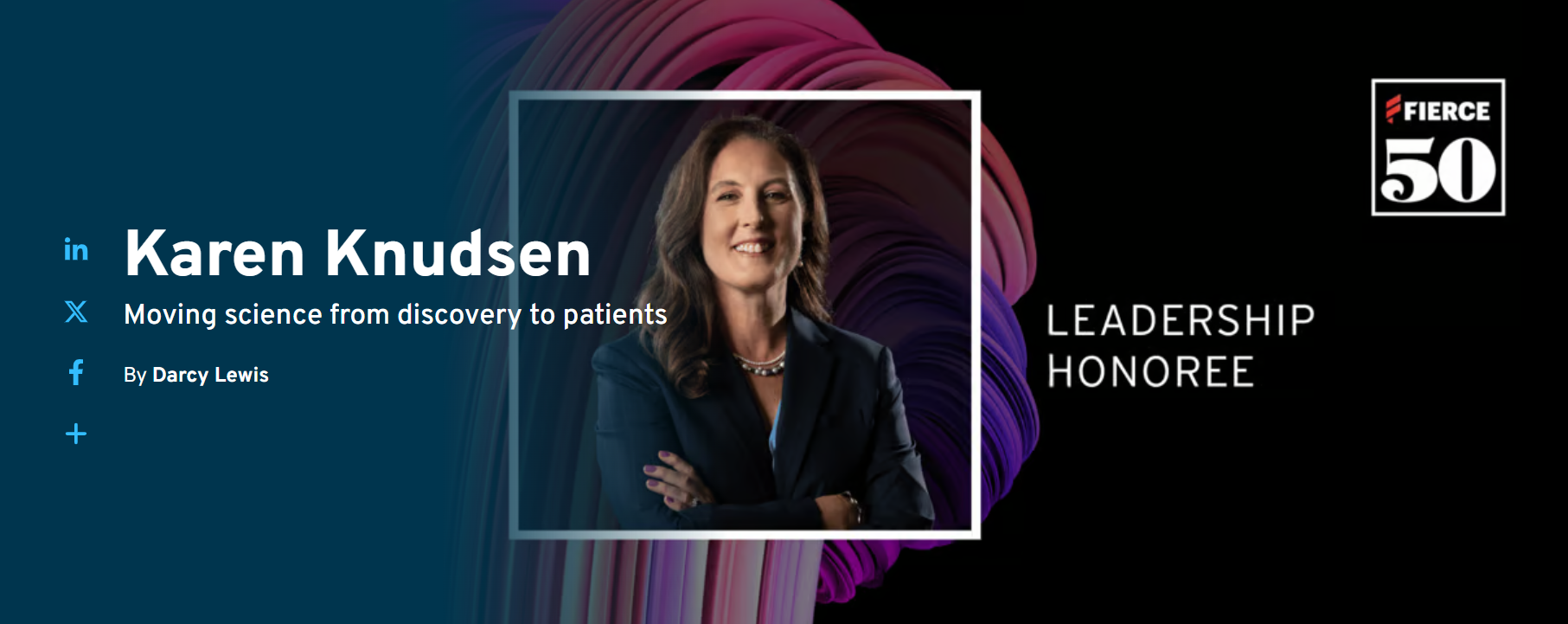
Fierce 50 of 2026 | Leadership Honorees | Dr. Karen Knudsen
Karen KnudsenWhen Daniel Burnham uttered the famous phrase “Make no little plans, for they have no power to stir men’s blood,” he was referring to the brash, booming metropolis of 1910 Chicago. But he could have been referring to the Parker Institute for Cancer Immunotherapy, which accelerates the development of breakthrough immune therapies through a collaborative consortium that fuels high-risk, high-reward science with shared goals, data and infrastructure. Or he could have been referring to its charismatic CEO, Karen Knudsen, Ph.D.
Throughout her career as a translational cancer researcher, health system leader and nonprofit executive, Knudsen has been frustrated by what she calls the “uncomfortable middle” in cancer research. Researchers too often come up with promising ideas that languish in the laboratory, unable to secure the resources needed to reach clinical testing as traditional venture capital shifts toward later-stage projects.
“The Parker Institute is willing to de-risk non-incremental, exceptional science with the potential to be game-changing and pull others along to get it into clinical testing and ultimately to change practice,” she said. That mission ultimately drew Knudsen to the Parker Institute when founder Sean Parker approached her about becoming CEO.
Parker lured Knudsen away from a high-profile tenure as CEO of the American Cancer Society, where she oversaw the organization’s transformation following a challenging merger of its former federated societies.
“They needed someone who knew oncology, M&A, and how to build a modern oncology organization that would improve lives,” she said. “I was very proud to have led the transformation to refocus the mission, expand direct patient support, build a robust advocacy arm, and launch the BrightEdge impact innovation fund.”
Born into a military family that prized resourcefulness and resilience, Knudsen had lived in 11 houses by the time she graduated from high school. Although she had never met a scientist before attending college, she quickly found her footing.
“I can't remember a time when I didn't dream about doing something to improve human health through discovery,” she said. “Using data to synthesize and generate creative ideas to solve for problems that visibly improve lives for people is what drives me as a scientist, a healthcare executive, and a CEO.”
Knudsen’s first professional successes came in the scientific realm, where she has amassed more than 200 scientific publications. Her team integrated clinical and molecular data to identify DNA repair pathways as a vulnerability in androgen-driven prostate cancer. Her team was also the first to propose targeting DNA repair processes with PARP inhibitors in advanced prostate cancer, an idea later validated through multi-institutional collaborations and clinical trials.
Knudsen eventually broadened her reach into healthcare administration, continuing to operate her lab even as she rose to executive vice president of oncology services for Jefferson Health and director of the Sidney Kimmel Cancer Center. But she had to close her lab when she took the reins at the American Cancer Society, a loss she still feels deeply.
“I needed to have a hard conversation with myself about whether I could have even more impact at the ACS, and the answer was yes,” she said.
Starting with her childhood vision of herself as a scientist, Knudsen has long had a clear sense of purpose and has been willing to move on once she feels her goals for an organization have been met.
“At ACS, as proud as I was of what we did, a sense of urgency developed in me because all this great science was piling up, due to reduced capacity to bring it into translation in the clinic,” she said.
That’s why the Parker Institute is a good fit for Knudsen, and vice versa. Its three-pronged approach starts with funding science through master agreements with 14 Parker Institute sites nationwide, allowing investigators to freely share techniques and data. The consortium also has an agreed-upon strategy for what happens when researchers make a discovery with significant potential.
The second component centers on curating that scientific discovery engine.
No matter what I’ve done, the goal is always the same: Science to people.
“We embed in the technology transfer office at our sites and have a vision of how all of the discoveries made by our investigators can be bundled to create maximum value,” Knudsen said. “That’s something no one investigator or institution can do on their own. Then our innovation team patents the ideas, and they’re either licensed out or we continue to develop them in-house.”
Third, the Parker Institute’s venture arm can create or back new companies based on discoveries made through the consortium.
“We’ve got some exciting strategies right now, all focused on shortening that timeframe by which a discovery gets to FDA approval,” Knudsen said. “Over the last nine years, we've had 17 companies that we've either started or helped to capitalize so they can flip over into that clinical testing.”
Reflecting on her career to date, Knudsen remains energized by the same forces that have always driven her, now coupled with the opportunity to help promising projects advance.
“No matter what I’ve done, the goal is always the same: Science to people,” she said. “Being able to contribute by helping develop a new mechanism that moves science along faster and more smoothly as at the Parker Institute feels like exactly what I’m meant to be doing.”