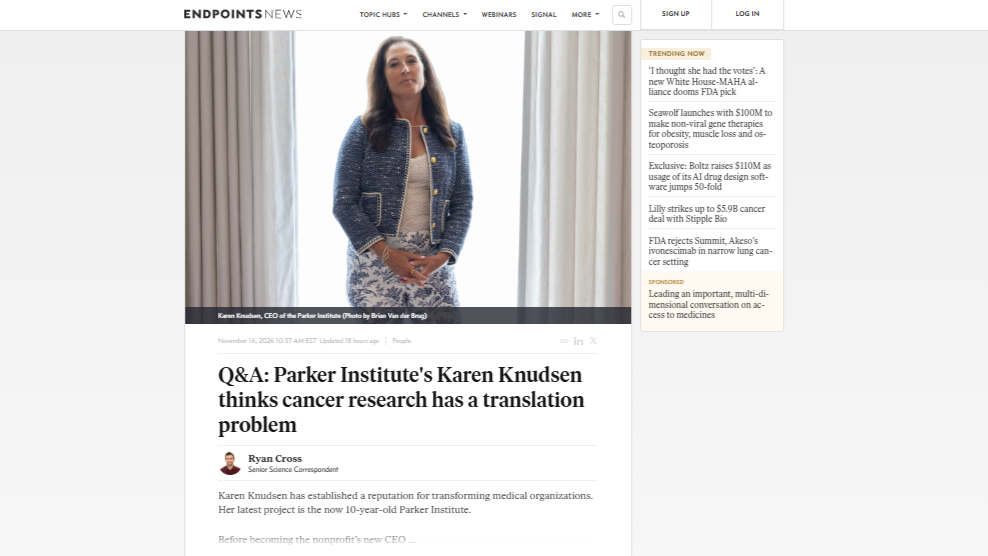
Q&A: Parker Institute's Karen Knudsen thinks cancer research has a translation problemunch a business.
Karen Knudsen has established a reputation for transforming medical organizations. Her latest project is the now 10-year-old Parker Institute.
Before becoming the nonprofit’s new CEO last year, Knudsen led a turnaround of the American Cancer Society, which she said had lost money seven years in a row before she overhauled its business. Then came the call from tech billionaire Sean Parker, who had been personally leading PICI since 2020. Its work has become increasingly important today as big drugmakers back out of the cancer immunotherapy field.
Knudsen: I don’t think that we should be trimming the basic science. This engine is working, and we want it to keep going, but what’s been completely starved is the translational piece. We have a pile-up of really good discoveries that can’t go anywhere because we don’t resource translation into the clinic. And that includes the minting of physician-scientists, who are on the decline in the US because we are not signaling stability about the funding.
Talent follows stability. When there are threats from the executive branch that we’re going to cut funding, that signals instability. China and Australia have become great places to innovate and conduct clinical research. That’s great for humanity. I think the competition is good. But what does it mean if Phase 1 clinical trials go entirely overseas and people can’t get access to these breakthroughs?
If we’re not, in the US, providing an outlet for our scientific discovery to move toward patient benefit, others will step into that void, and that’s what we’re seeing.
EndPoint News, Ryan Cross-Senior Science Correspondent, November 16, 2026